In the world of investment funds, the terms fund management and fund administration are often used interchangeably. But these two functions serve very different — yet equally critical — roles in the lifecycle of a fund.
As modern funds become more global, digital, and complex, it’s essential for fund managers, GPs, LPs, and even investors to understand the distinction. At aama.io, we’ve built infrastructure that empowers both sides of the fund equation.
What is Fund Management?
Fund management refers to the strategic oversight of an investment fund. Fund managers are responsible for:
- Defining the fund’s investment thesis and asset allocation strategy
- Making buy, sell, or hold decisions
- Monitoring portfolio performance and adjusting strategy as needed
- Engaging with investors and raising capital
In short, fund management is about growing investor capital through smart, risk-adjusted decisions.
What is Fund Administration?
Fund administration focuses on the operational, accounting, and compliance functions that keep a fund running smoothly. Fund administrators handle:
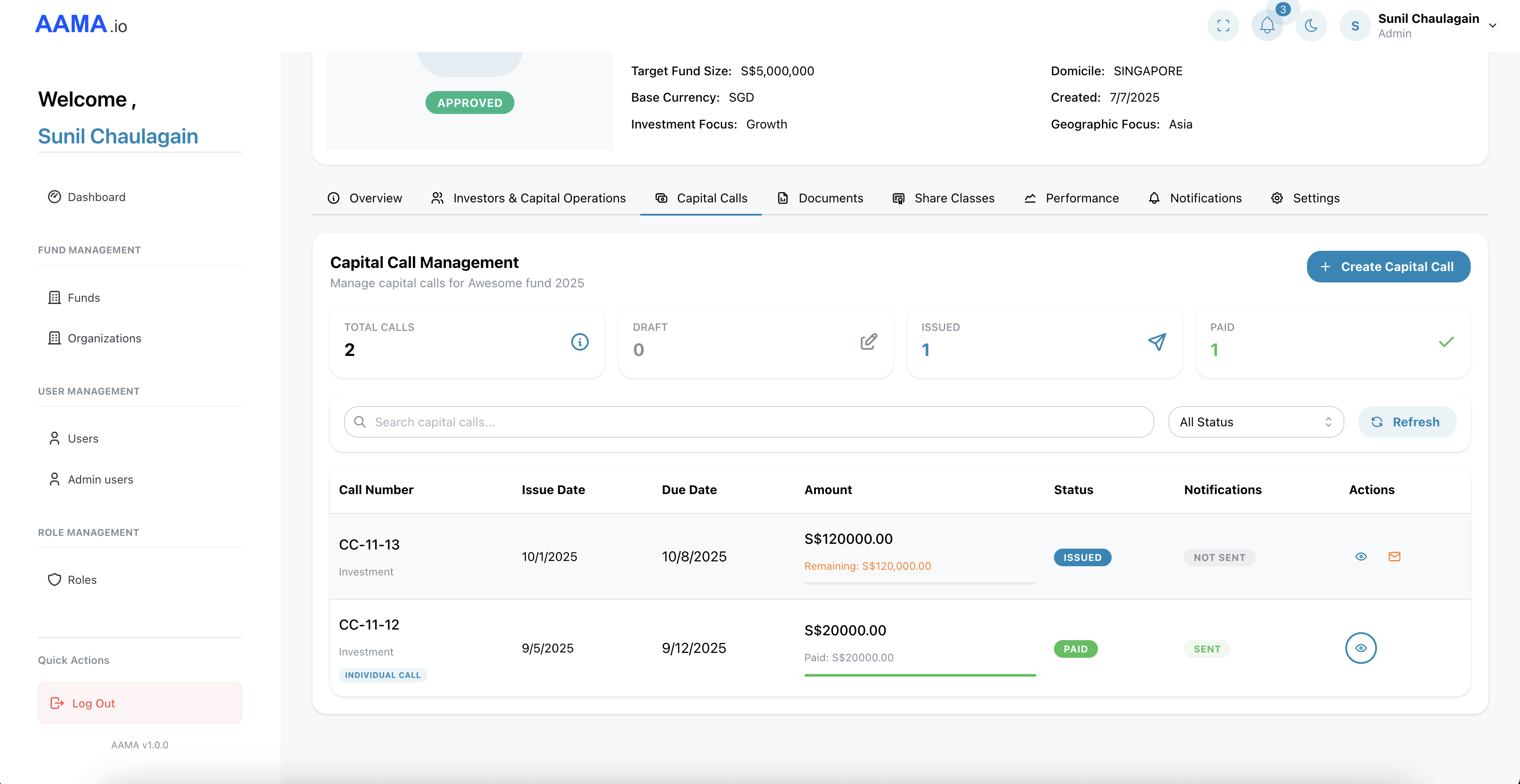
- Capital call processing and investor allocation tracking
- Fund accounting, NAV (Net Asset Value) calculation, and reporting
- Maintaining books and records
- Investor onboarding with KYC/AML checks
- Regulatory filings and compliance documentation
While they don’t make investment decisions, administrators ensure accuracy, transparency, and compliance — building trust among LPs and regulators.
Why the Distinction Matters
As funds grow more sophisticated — spanning PE, VC, REITs, SPVs, and tokenized vehicles — the need for clear separation of duties becomes more important. Operational errors or regulatory missteps in administration can undermine even the best investment strategies.
That’s why at aama.io, we’ve built a unified software where fund managers can focus on performance, while our built-in fund administration modules handle compliance, accounting, and reporting at scale.
Comparison Snapshot
| Aspect | Fund Management | Fund Administration |
|---|---|---|
| Primary Role | Investment strategy and portfolio growth | Operational execution and compliance |
| Responsibilities | Asset allocation, trading, investor relations | NAV, accounting, reporting, KYC/AML |
| Key Stakeholders | Fund managers, CIOs, GPs | Administrators, accountants, auditors |
| Tools | Portfolio administration systems (PMS) | Fund admin software, compliance engines |
Bringing It All Together with aama.io
Whether you're launching a venture fund, managing a mutual fund, or tokenizing a family office vehicle — both fund management and fund administration must work in harmony.
aama.io offers a comprehensive infrastructure where:
- Fund managers can plan investments, issue capital calls, and visualize portfolio performance
- Fund administrators can manage ledgers, automate NAV, run compliance checks, and distribute reports
- Fund managers and administrators can work together to manage the fund lifecycle
All in one place. All in real time.
Understanding the difference between these functions is the first step. Adopting a unified digital software like aama.io is the next.
Explore how aama.io powers the future of fund lifecycle administration.