
When a fund administrator looks at a Singapore Variable Capital Company (VCC), they are rarely asking for another incorporation checklist. They already know the legal shape: one umbrella, several sub-funds, assets and liabilities ring-fenced. What they need to know is whether the books match that promise — every day, not only at audit.
That is the question we get from administrators and outsourced CFOs evaluating aama.io: how do you handle VCC in accounting? This is the operational answer — what the platform enforces, what sits on the umbrella versus the sub-fund, and how reporting works without turning the umbrella into a second set of conflicting books.
The hierarchy the books actually need
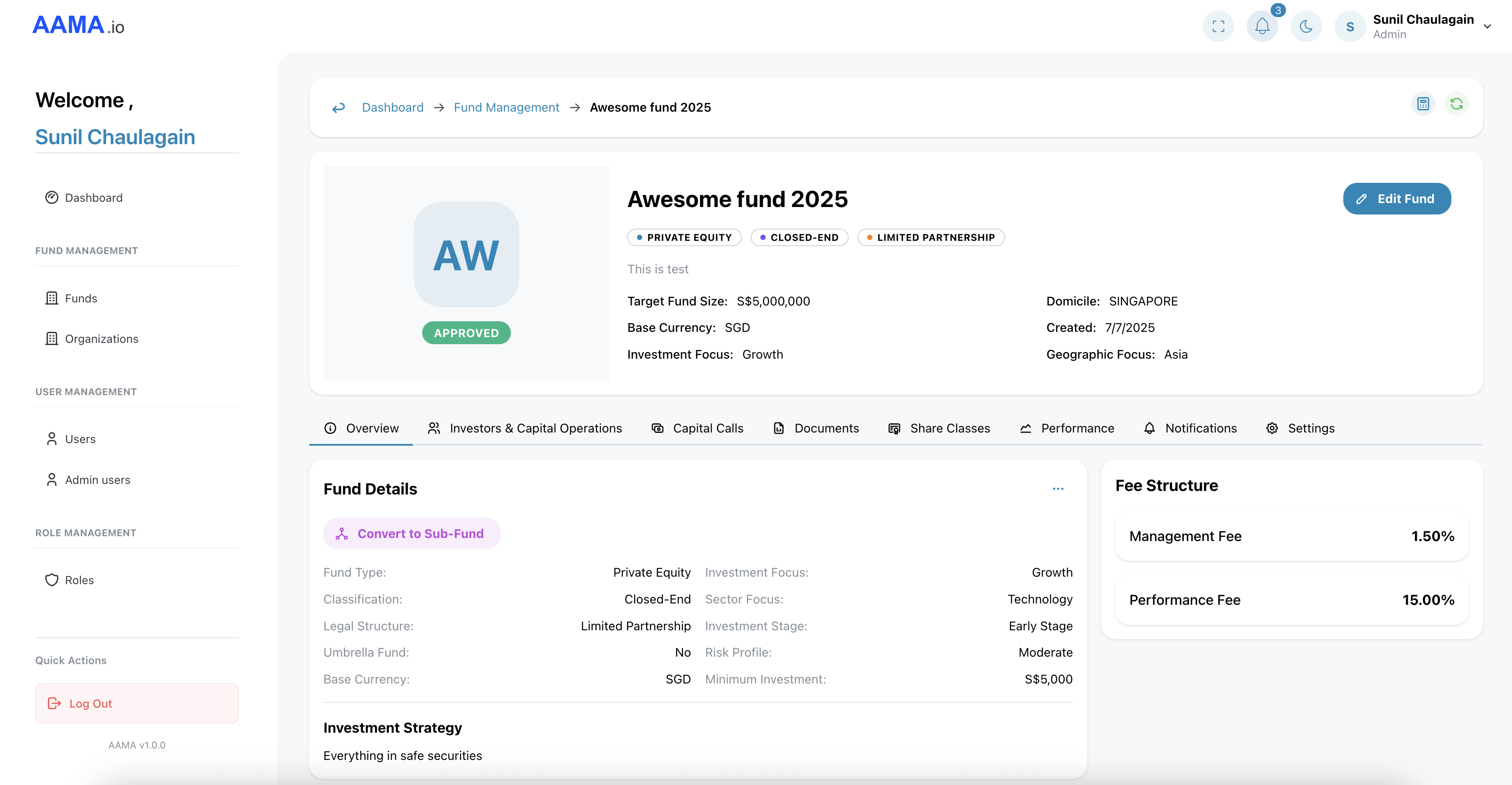
On aama.io a VCC is not a separate product module. It is a fund hierarchy with hard rules:
- Legal structure = VCC identifies the vehicle as a VCC (umbrella or sub-fund).
- Umbrella flag is allowed only on VCC funds — you cannot mark an LP or LLC as an umbrella and pretend it is the same thing.
- Parent link attaches a sub-fund to a VCC umbrella only. An umbrella cannot also have a parent (no multi-level nesting).
- When a sub-fund is attached, it inherits VCC as its legal structure so the hierarchy cannot drift into mixed vehicle types.
Those rules live in both the fund portal and the accounting layer, so a structure that was set up correctly in onboarding stays correct when someone opens the books.
Where the ledger lives: sub-fund first
For day-to-day fund administration, the working assumption is simple:
- Sub-funds hold investors, capital calls, NAV, fees and most of the general ledger activity.
- The umbrella is the legal shell and the parent in the hierarchy — not a dumping ground for untagged journals.
- Each fund (umbrella or sub-fund) has its own books. Reporting for a sub-fund does not silently pull sibling balances.
That matches how administrators already think about ring-fencing. Soft “tags” on a shared ledger are how segregation fails quietly; separate fund books with an explicit parent relationship are how it holds up when an auditor asks for a trial balance per sub-fund. We go deeper on that failure mode in VCC sub-fund segregation and the renewal pack.
What “umbrella consolidation” means in the platform
GPs still want a single view across strategies. aama.io’s umbrella consolidated BS / P&L is built for that: pick an approved VCC umbrella and an as-at date, and the system rolls up ledger balances from each active sub-fund into a pack the administrator can review.
Three details matter for fund admins:
- VCC-only. Consolidation is available for VCC umbrellas, not for any fund that someone casually flagged as “parent.”
- Sub-fund columns. The pack keeps sub-fund identity visible — you can see which child contributed which balances, not only a blended total.
- Roll-up, not legal consolidation with eliminations. The view sums sub-fund ledgers for management and oversight. It is labelled and used as a consolidated reporting pack, not a substitute for statutory accounts prepared under your engagement letter and applicable standards.
If a sub-fund has no financial year covering the as-at date, that child is skipped with a warning rather than inventing balances — so month-end does not hide incomplete books behind a clean total.
Firm-level AUM and MAS-facing numbers
When firm AUM is assembled for MAS-style reporting (for example QDC Basic packs), umbrella NAV is not double-counted with its sub-funds. The platform treats the umbrella shell differently from the sub-funds that hold the economic NAV — which is what administrators expect when one VCC houses several strategies.
That does not replace your MAS filing judgement or a licensed adviser’s sign-off. It does stop the most common spreadsheet error: adding umbrella and sub-fund NAVs and overstating AUM.
How a typical admin workflow looks
- Set up the umbrella as VCC with the umbrella flag in fund setup (synced into accounting).
- Open each sub-fund under that parent — strategy, currency and investors per child.
- Book and close on the sub-fund — journals, NAV, investor activity stay on the child ledger.
- Produce umbrella packs when the GP or IC wants a cross-strategy view.
- Export per sub-fund for auditors, banks and tax advisers who need ring-fenced statements.
What this is not
aama.io does not incorporate the VCC, appoint your directors, or replace ACRA/MAS filings. Structure choice, grant schemes and tax incentives (13O/13U) are covered in our setup guides — start with How to set up a VCC in Singapore and Section 13O vs 13U. The accounting layer’s job is narrower and harder: keep the hierarchy honest after the lawyers have gone home.
This article is general product and operational information, not accounting, tax or regulatory advice. Confirm statutory reporting, consolidation policy and MAS submissions with your licensed advisers.
Evaluating aama.io for a VCC book of business? Book a walkthrough with our team — bring one umbrella and two sub-funds and we will show the ledgers, the consolidated pack and how AUM aggregation behaves on your structure. For the legal setup path, use the umbrella vs standalone comparator and VCC cost estimator.